Tristan und Isolde
Music and libretto by Richard Wagner
Metropolitan Opera House
New York, NY
March 9–April 4, 2026
Set Design: Es Devlin
Video Design: Ruth Hogben
Choreography: Annie-B Parson
Costume Design: Clint Ramos
Projection and Laser Design: Jason H. Thompson
Lighting Design: John Torres
Metropolitan Opera Orchestra
Conductor: Yannick Nézet-Séguin
Metropolitan Opera Chorus
Chorus Director: Tilman Michael
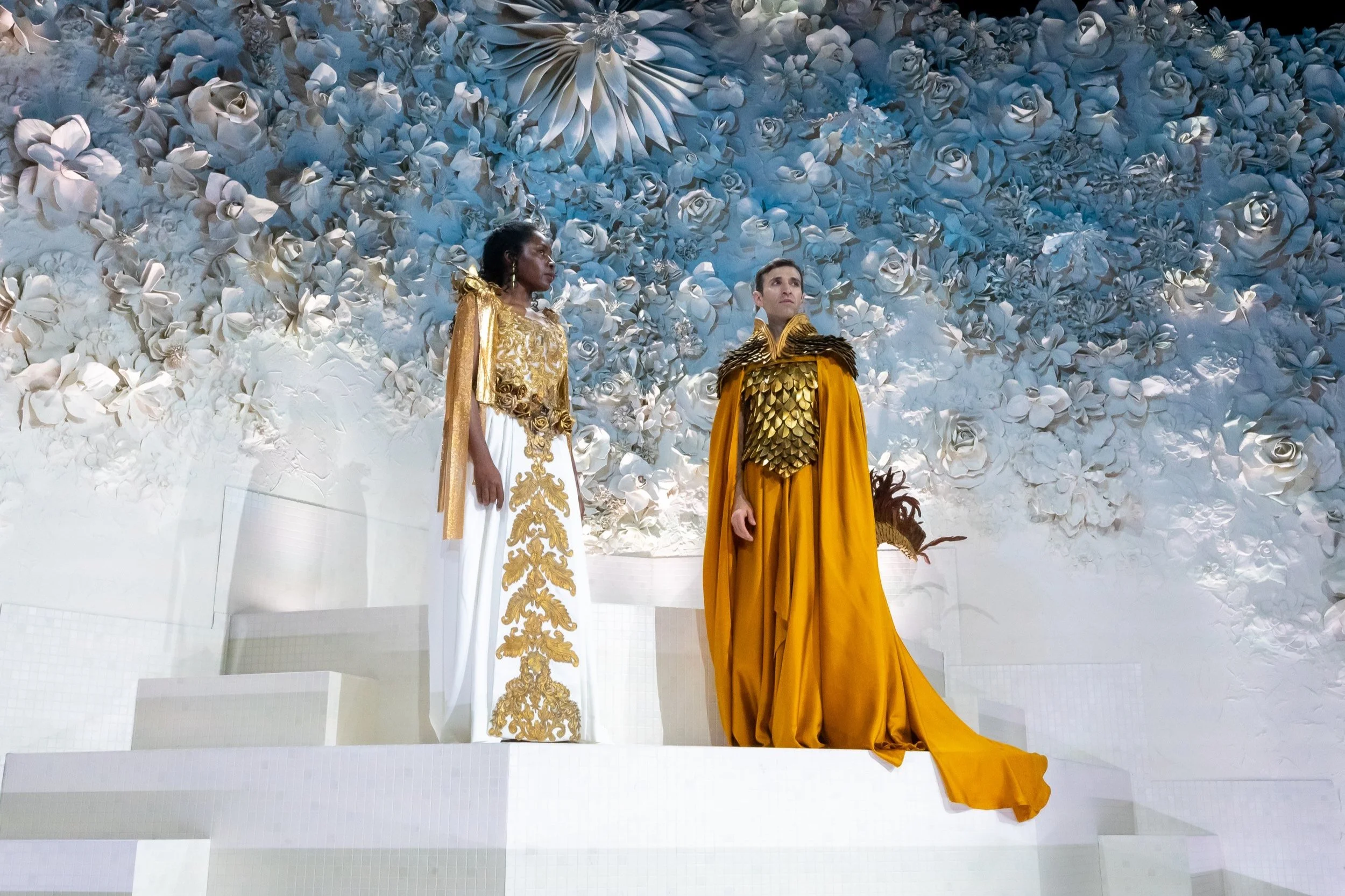
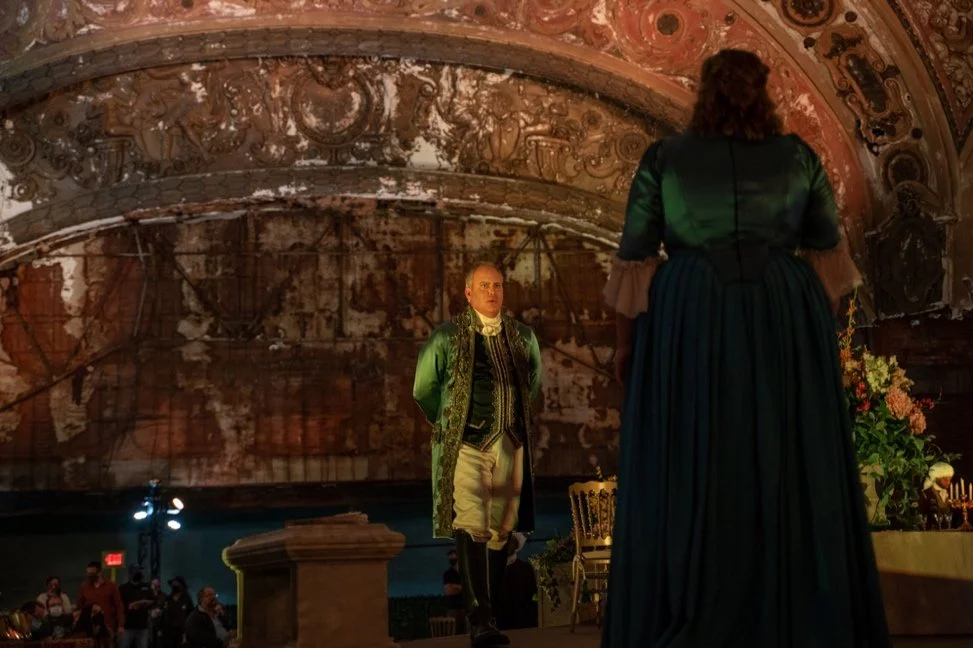
Yuval Sharon's Metropolitan Opera debut production of Tristan und Isolde takes Wagner’s infatuation with Dharmic philosophy, acquired by way of Schopenhauer, as an opportunity to meditate on the themes of death and rebirth within the opera while recasting the undertaking of a new opera production as a communal ritual in and of itself.
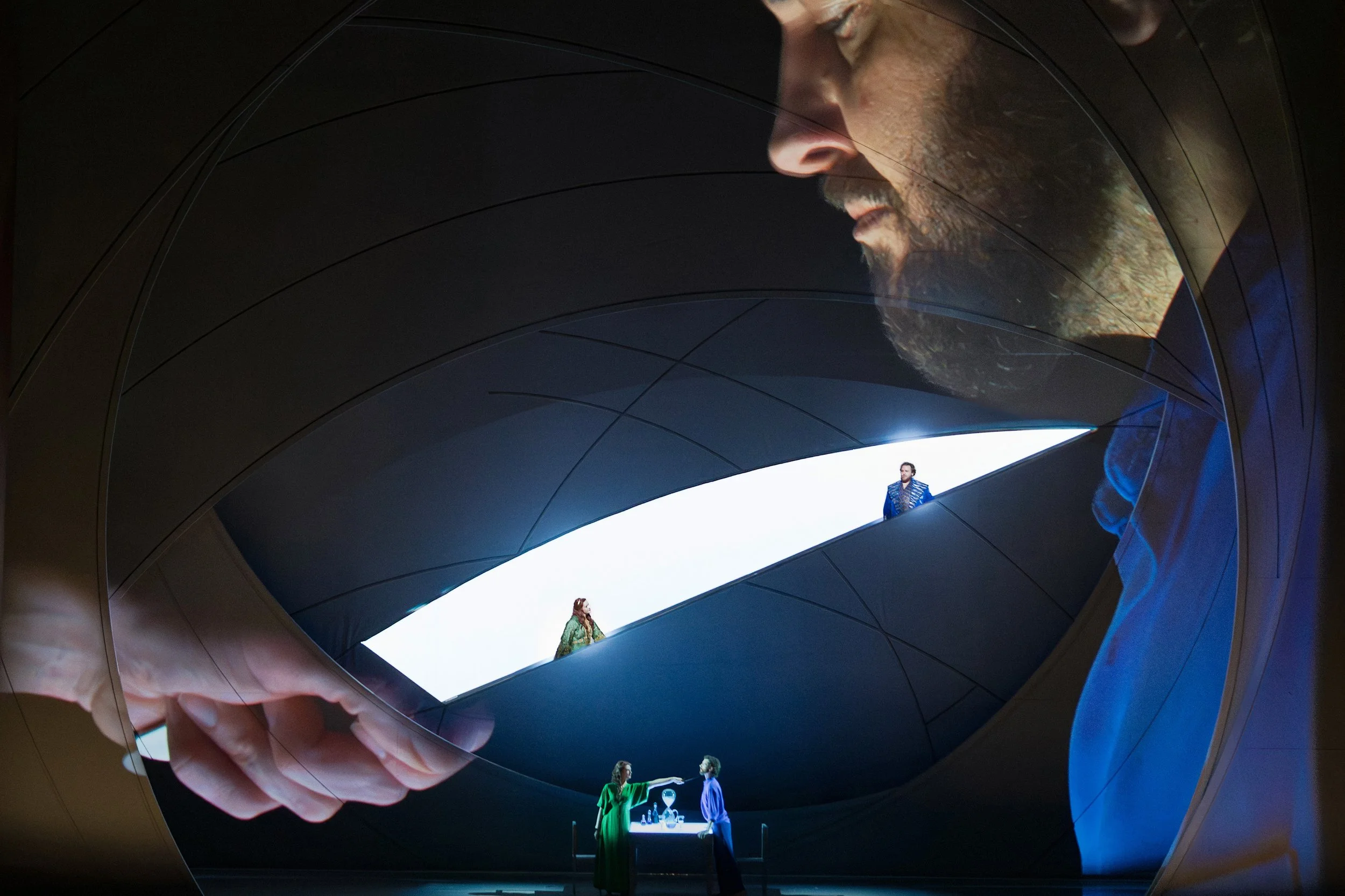
Sharon stages this enduring mystery in two sets designed by Es Devlin. The first is a table at which a pair of lovers—contemporary stand-ins for Tristan and Isolde—sit with a spread of totemic objects, all magnified and projected across the entirety of the stage. As they manipulate the objects on their table, the story is set in motion: a jug of water becomes the ocean that carries Tristan’s ship, the momentary gleam of a knife a stage on which Tristan and Isolde’s fate is revealed. The most ordinary of people and objects become imbued with mythic stature, containing infinite worlds of nested stories within.
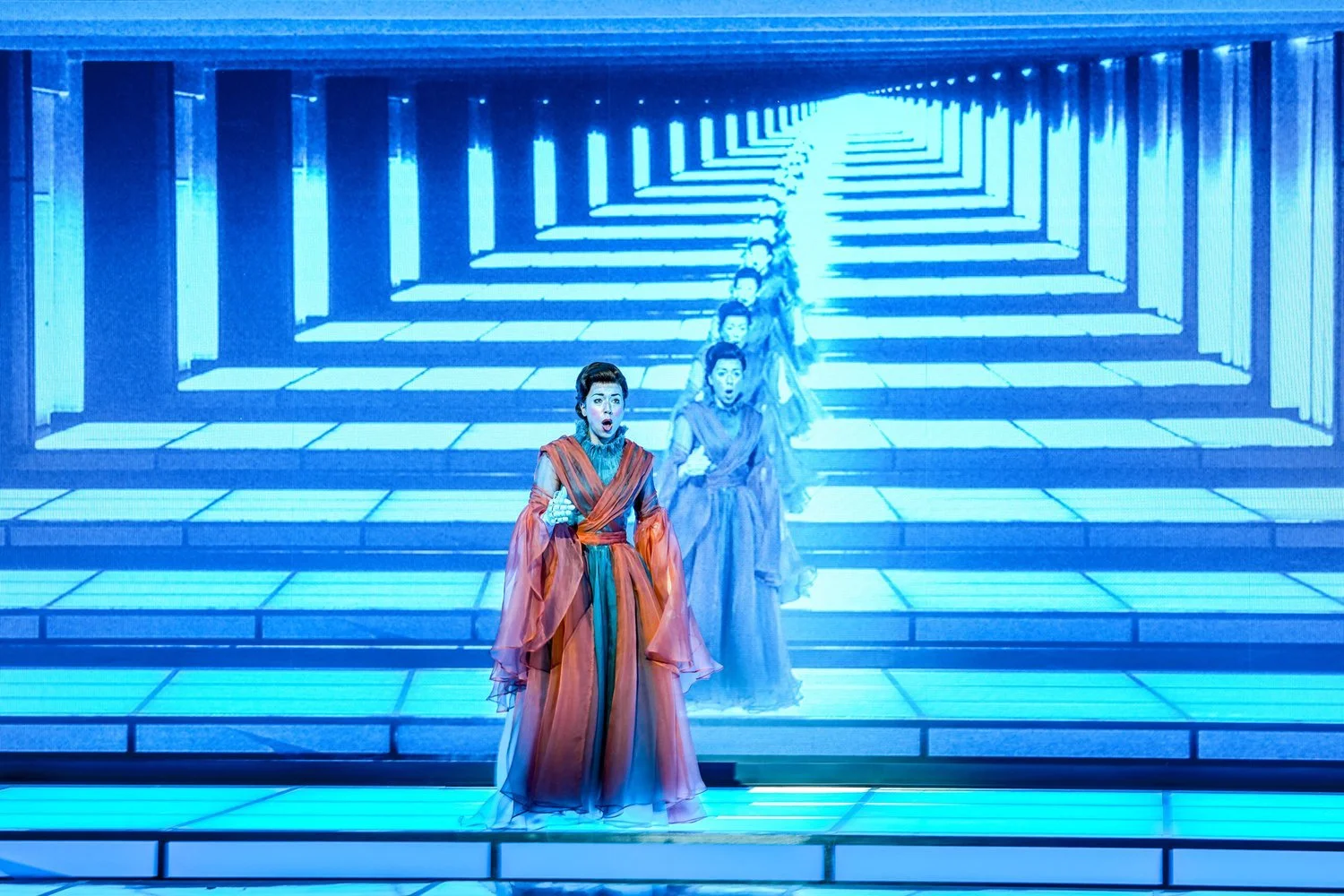
Sharon’s understanding of the opera as a ritualistic reenactment of the life-death-rebirth cycle is underscored by the second setting: a tunnel, which first appears in fragmented glimpses before becoming the main setting for Act III. Tristan spends much of this act in a state between life and death, the latter of which he likens to a return to the womb. Sharon identifies this state with the Tibetan Buddhist concept of the bardos of dying: the pain of death, the transfiguration of rebirth, and a medial stage characterized by introspection, clarity, and ultimately acceptance. The tunnel represents this act's status as a passage between destinations, a last embrace of the interstitial before the characters, cast, and audience are all delivered through death and—catalyzed by Isolde's final ecstasy—into rebirth.
Tristan und Isolde premiered to immediate and universal acclaim, leading the Met to extended the premiere run.
Photo credits:
Jonathan Tichler / The Metropolitan Opera (1–7)
Kinga Karpati and Daniel Zarewicz (8–13)
Karen Almond (14 & 15)
Così fan tutte
Music by Wolfgang Amadeus Mozart
Libretto by Lorenzo Da Ponte
Detroit Opera House
Detroit, Michigan
April 5-13, 2025
Director: Yuval Sharon
Scenic Designer: dots.
Sound Designer: Jody Elff
Lighting Designer: Yuki Nakase Link
Costume Designer: Oana Botez
Wig and Makeup Designer: Joanne Middleton-Weaver
Projection Designer: Yana Biryukova and Hana S. Kim
Conductor: Corrina Niemeyer
In this production, Yuval Sharon grapples with the misogynistic aspects of Mozart and Da Ponte’s dark comedy about human relationships, transforming the narrative into an exploration of human bias through the lens of AI.
Drawing inspiration from the opera’s original subtitle, “The School for Lovers,” Mozart’s enthusiasm for then-cutting-edge musical and stage machinery, and Julien Offray de La Mettrie's 1747 philosophical treatise Man a Machine, Sharon recasts the lovers as AI test subjects in an experiment to create the perfect artificial lover.
Likewise, he reimagines the old and jaded Don Alfonso as a red-pilled techbro, with a combination of Steve Jobs-style tech optimism and the obsessive delusion of the manosphere. The CEO of SoulSync Technologies, Alfonso prepares to roll out a new product: a perfect AI lover. Using junior engineers Ferrando and Guglielmo's prototypes Dorabella and Fiordiligi as test subjects, and joined by his own creation, Despina, Alfonso initiates a stress test to see if his new product will succumb to what he perceives as the innate tendency of human women to be unfaithful.
That Alfonso's test stems from his own insecurities and biases—and that he must put his finger on the scale to achieve his desired outcome—is a constant between both the original story and Sharon's rereading, and ultimately forms the crux that transforms the piece from a celebration of misogyny to a critique of it. Likewise, it presents a throughline to modern AI, which can be trained only on pre-existing materials and ultimately reflects the biases of those materials and the people who created them.
Photo credits: Austin Richey/Detroit Opera.
The Comet/Poppea
WAREHOUSE
Geffen Contemporary at MOCA
Los Angeles, California
June 14–23, 2024
Concept and Direction: Yuval Sharon
Music (The Comet): George Lewis
Libretto: Douglas Kearney
Music (L'incoronazione di Poppea): Claudio Monteverdi
Libretto: Giovanni Francesco Busenello
Music Director: Marc Lowenstein
Scenic Designer: Mimi Lien
Lighting Designer: John Torres
Costume Designer: Oana Botez
Sound Designer: Mark Grey
Dramaturgy: Robert Gooding-Williams and Wendy Heller
The Comet / Poppea brings together seemingly disparate worlds connected by stories of cultural transformation. The work juxtaposes Claudio Monteverdi’s L’incoronazione di Poppea (The Coronation of Poppea), an Italian opera from 1643 unfolding among the social divisions of ancient Rome; and the world premiere of The Comet, based on the 1920 science-fiction short story by sociologist and Pan-Africanist civil rights activist W.E.B. Du Bois. Set in 1920s New York City, “The Comet” depicts a Black man and white woman as the only survivors after a comet hits Earth.
Presented on a turntable divided in two halves, these worlds unfold simultaneously, with the stage’s rotation creating a visual and sonic spiral for audiences—inviting associations, dissociations, collisions, and confluences.
Photography by Austin Richey, Courtesy MOCA and The Industry.
Europeras 3 & 4
Music by John Cage
Gem Theatre
Detroit Opera
Detroit, Michigan
March 8-10, 2024
Director: Yuval Sharon
Production Designer: Moníka Essen
Lighting Designer: Yuki Nakase Link
Associate Director: Alexander Gedeon
Whereas John Cage’s first opera, Europeras 1 & 2, attempted to replicate the spectacle of grand opera through the collage-like lens of indeterminacy, Europeras 3 & 4 saw the composer explore the genre on a much smaller scale—though no less idiosyncratically. Europera 3, composed for a relatively restrained ensemble of six singers, two pianos, six gramophones, tape, and lighting, takes on the appearance of a chamber opera. Europera 4 dials the scale back further, with its forces of two singers, one piano, one gramophone, and table lamp evoking a song recital.
In a reflection of this intimate setting—and in order to advance Detroit Opera’s mission to bring opera out of the opera house and into the Detroit community—Yuval Sharon elected to stage Europeras 3 & 4 in the cabaret-like Gem Theatre, the first live theatrical performances at the historic venue in nearly twelve years. Like the other compositions in the series, Europeras 3 & 4 call for music to be dictated by chance, and sets, props, and costumes to be procured from the presenting company’s archives. The result was an unrepeatable living artwork composed of familiar, interwoven arias and musical cues, juxtaposed against one another in new musical and visual contexts that invited audience members to find as much—or as little—meaning as they desired.
Photography by Austin Richey courtesy of Detroit Opera.
Orfeo
Music by Claudio Monteverdi
Libretto by Alessandro Striggio
Santa Fe Opera
Santa Fe, New Mexico
July 29-August 24, 2023
Orchestration: Nico Muhly (World Premiere)
Conductor: Harry Bicket
Director: Yuval Sharon
Visual Environment Designer: Matthew Johnson and Alex Schweder
Lighting Designer: Yuki Nakase Link
Projection Designer: Hana S. Kim
Sound Designer: Mark Grey
Costume Designer: Carlos J. Soto
Yuval Sharon made his Santa Fe Opera company debut with a new production of Claudio Monteverdi's 1607 opera Orfeo. Commonly regarded as the oldest surviving opera, Orfeo tells the timeless story of the legendary musician's descent into Hades to win back the life of his deceased bride. Harry Bicket conducted the world premiere of Nico Muhly's orchestration, which updates Monteverdi's Baroque-era instrumentation.
Sharon's Orfeo united innovative stagecraft, practical effects, and the physical environment itself to advance the drama of the opera. In an effort to portray the two worlds of Orfeo, while accounting for the theater's lack of a proscenium, Sharon aimed for a staging that would allow both to flourish onstage seamlessly. Finding inspiration in astronomical devices of antiquity such as the astrolabe, Sharon's team devised a solution: one single set piece that can open and close to reveal a hidden underworld, the movements of which are inextricably connected to the world of the living above.
Sharon’s production also invokes another major element of the opera: music itself. As both a character and a major driver of the action, music takes center stage in Orfeo; Sharon sought ways to bring it to life in the set that reflected its pervasive presence in the opera. Using projections and mist, Sharon’s Orfeo gives form to music by visualizing the air that carries it. In doing so, he also evokes Orfeo’s travels through a land beyond human comprehension.
Photography by Richard Barnes.
Proximity
The Walkers
Composed by Daniel Bernard Roumain with libretto by Anna Deavere Smith.
Four Portraits
Composed by Caroline Shaw with libretto by Caroline Shaw and Jocelyn Clarke.
Night
Composed by John Luther Adams with libretto by John Haines.
Lyric Opera of Chicago
Chicago, Illinois
March 24-April 8, 2023
Director: Yuval Sharon
Conductor: Kazem Abdullah
Production Designers: Jason H. Thompson and Kaitlyn Pietras
Sound Designer: Jody Elff
Costume Designer: Carlos J. Soto
Choreography: Rena Butler
Proximity comprises three newly-commissioned operas, curated by Renée Fleming for Lyric Opera of Chicago. The Walkers, composed by Daniel Bernard Roumain with libretto by Anna Deavere Smith, uses field work and interviews to give voice to families grappling with gun violence in Chicago; Four Portraits, composed by Caroline Shaw with libretto by Jocelyne Clarke, interrogates the impact of technology on society and the human desire for connection; and Night, a setting of a text by the late poet John Haines composed by John Luther Adams, ruminates on the fragility of the natural world.
Sharon’s wold premiere production highlights the humanity and connection core to the piece, splicing and shuffling the three operas to create an entirely new work that zooms in and out from the scale of the individual to the community to the cosmic.
Enhancing the three shuffled narratives is a stage design on a scale and complexity never before attempted in opera: a monumental curved quarter-pipe video wall, 40 feet wide by 26 feet high, made of 140 LED panels and 240 black marble LED panels, designed by Jason H. Thompson and Kaitlyn Pietras. Complemented by a robust on-set system of responsive cameras and other interactive features, the set design for Proximity affords audiences a new immersive way to experience opera.
Photography provided courtesy of Lyric Opera.
The Valkyries
Die Walküre (Act III)
Music by Richard Wagner
Hollywood Bowl
Los Angeles, California
July 17, 2022
Additional performances at Detroit Opera House
September 17-20, 2022
Director: Yuval Sharon
Associate Director: Diana Wyenn
Production Designers: Jason H. Thompson and Kaitlyn Pietras
Lighting Designer: Pablo Santiago
Lead Technical Artist: Andrea Carver
Technical Artists: Eli McCaffrey, Thomas Hamilton and Mikayla Wenzel
Technology Integration Lead: Derek Christiansen
Disguise Programmer: Simón Anaya
Costume Designer: Carlos Soto
Conductor: Gustavo Dudamel (Los Angeles), Sir Andrew Davis (Detroit)
Yuval Sharon’s staging of Die Walküre, Act III, The Valkyries, uses green-screen technology to seamlessly blend onstage action with real-time computer graphics and animation, created by Jason Thompson and Kaitlyn Pietras of PXT Studio. Beginning with a world built in Unreal Engine, a tool typically designed for the video game industry, Sharon worked with Thompson and Pietras to storyboard the piece, using VR headsets to place virtual cameras throughout the digital landscape as if he were a film director working on location. These virtual cameras—which can be automated, panned, and zoomed with all of the flexibility of a physical camera—work in conjunction with five robotic cameras which capture the performers from a variety of angles onstage in front of a 16-foot green-screen. As the performance unfolds onstage, the feed from the physical cameras and virtual cameras are then synthesized, with real-time video effects used to keep color grading consistent, and to help the performers blend into the virtual environment. The end result is a live film that exists dynamically with the onstage performance, while still being replicable on a shot-for-shot basis; audiences are free to watch the action on-stage and on projection screens simultaneously, considering the uneasy relationship between live performance and new media in opera’s future.
Photography courtesy of the LA Phil/Detroit Opera.
La bohème
Music by Giacomo Puccini
Libretto by Giuseppe Giacosa and Luigi Illica
Detroit Opera House
Detroit, Michigan
April 6-12, 2022
Co-produced with Boston Lyric Opera and Spoleto Festival USA
Director: Yuval Sharon
Set Designer: John Conklin
Lighting Designer: John Torres
Costume Designer: Jessica Jahn
Conductor: Roberto Kalb
Premiered at Detroit Opera in 2022, and with further performances at Spoleto Festival USA, Opera Philadelphia, and Boston Lyric Opera, Sharon’s La bohème casts familiar elements in a new light as he stages the work in reverse order from Act IV to Act I. In this new arrangement, Sharon reappraises the ways in which audiences and artists can interact with repertoire, bringing fresh eyes and ears to a classic while extracting hope from tragedy, life from death, and love from loneliness. The end result is an opera that begins with death and tragedy, but ends with a world of promise and potential amidst a new love—and an audience left not with the heaviness of inevitability, but with the notion that the pain was worth the fleeting moments of joy.
In order to keep the narrative of the reverse staging cohesive, Sharon introduces a new role: The Wanderer, portrayed in the premiere run by George Shirley. The Wanderer gives a spoken introduction to each act, helping the audience follow the reverse chronology of the story. In addition to his spoken introductions to each act, The Wanderer also appears in three new fourth-wall-breaking scenes; in each appearance, the action is put on hold as he asks the audience to consider which direction the story could have gone.
Photography by Austin Richey and Vesna Zdravkoski.
Bliss
Detroit Opera
In partnership with University Musical Society in Detroit, Michigan
Michigan Building Theatre
Detroit, Michigan
September 25, 2021
Director: Yuval Sharon
Set Designer: Moníka Essen
Lighting Designer: Heather DeFauw
Costume and Wig Designer: Suzanne Hanna
Conductor: Christopher Rountree
Bliss is a recreation of Ragnar Kjartansson's twelve-hour performance piece, restaged in the historic Michigan Building Theatre—the first live performance in that space since its conversion to a parking garage in the 1970s.
Bliss replays three minutes of The Marriage of Figaro with the same cast and same orchestra without pause for twelve hours. The scene—in which Count Almaviva pleads for, and ultimately wins, the Countess’s forgiveness—is looped seamlessly, creating a seemingly never-ending universe of repentance and grace.
Photography provided courtesy of Detroit Opera.
Twilight: Gods
Detroit Opera House Parking Center
Detroit, Michigan
October 17-20, 2020
Additional Performances at the Millennium Lakeside Parking Garage
Chicago, Illinois
April 28-May 2, 2021
Concept, Direction, and English translation: Yuval Sharon
With new narrative poetry: Marsha Music (Detroit) and Avery R. Young (Chicago)
Production Designer: Jason H. Thompson and Kaitlyn Pietras
Sound Designer: Mark Grey (Detroit)
Additional Music: Lewis Pesacov (Chicago)
Musical arrangement and orchestration: Ed Windels
Members of the Michigan Opera Theatre Orchestra (Detroit) and Lyric Opera Orchestra (Chicago)
Conceived and directed by Sharon, Twilight: Gods is a site-specific adaptation of Richard Wagner’s Götterdämmerung—the Twilight of The Gods—staged in the Detroit Opera House Parking Center (Michigan Opera Theatre) and Millennium Lakeside Parking Garage (Lyric Opera of Chicago).
Inspired as much by the brutal utilitarianism of the parking facility as the safety precautions of the coronavirus era, Twilight: Gods transforms Wagner’s six-hour masterpiece into an hour-long series of dioramic scenes performed in intervals throughout the Parking Center. Equal parts drive-in theater and opera house event, Twilight: Gods gives audience members the opportunity to watch Wagner’s drama unfold scene-by-scene from the safety of their cars, while the live performance (sung in English) is broadcast to car stereos—a full immersion in the world of the Ring.
Twilight: Gods is a collaboration between Michigan Opera Theatre and Lyric Opera of Chicago
Photography provided courtesy of Detroit Opera House.
Sweet Land
Los Angeles State Historic Park
World Premiere by The Industry
Los Angeles, California
February 29-March 15, 2020
Directors: Cannupa Hanska Luger and Yuval Sharon
Music: Du Yun and Raven Chacon
Libretto: Douglas Kearney and Aja Couchois Duncan
https://theindustryla.org/sweet-land-opera/
The latest piece from LA’s The Industry, Sweet Land brings together composers Raven Chacon and Du Yun, librettists Aja Couchois Duncan and Douglas Kearney, and co-directors Cannupa Hanska Luger and Yuval Sharon. Together, they spin separate but interconnected narratives that re-imagine the founding of America and westward expansion in order to make visible the violence and erasure of American history.
Sweet Land weaves together several narratives simultaneously, opening with the arrival of a settler-colonial civilization—titled the “Arrivals”—in the home of an indigenous civilization, known as the “Hosts.” From here, the audience diverges into two distinct paths: a feast and a train. The feast imagines the first meeting of the "Host" community and "Arrival" community. The train imagines the “Arrivals” embarking on an uncompromising westward expansion, and its violent effect on people, land, and animals. As the story unfolds, the audience is guided through the physical space of the park; as it progresses, past scenes are left behind and erased, emulating the erasure of dissent against dominant historical narratives. As the audience revisits past scenes, they find them replaced with narratives that are whitewashed, heavily biased, and bear little resemblance to the truthful events on which they are based.
Central to the project is the diversity of its voices. Composer Raven Chacon is from the Navajo Nation and advocates for indigenous composers and musicians; he is a recent recipient of the Berlin Prize. Du Yun is a Chinese immigrant whose recent work is rooted in a lack of understanding and empathy around immigration. Her opera Angel’s Bone, which explores human trafficking, won the Pulitzer Prize for music. Librettist Aja Couchois Duncan is a mixed-race Ojibwe writer with a focus on social justice. Douglas Kearney is a poet whose writing, in the words of BOMB magazine, “pulls history apart, recombining it to reveal an alternative less whitewashed by enfranchised power.” Co-director Cannupa Hanksa Luger is a multi-disciplinary installation artist of Mandan, Hidatsa, Arikara, Lakota, Austrian, and Norwegian descent.
Photography by Casey Kringlen.
ATLAS
Music by Meredith Monk
Los Angeles Philharmonic
Walt Disney Concert Hall
Los Angeles, California
June 11-14, 2019
LA Phil New Music Group
Conductor: Paolo Bortolameolli
Music Coach: Katie Geissinger
Music Advisor: Wayne Hankin
Director: Yuval Sharon
Artistic Advisor: Meredith Monk
Designer: Es Devlin
Projection Designer: Luke Halls
Choreographer: Danielle Agami
Costume Designer: Emma Kingsbury
Lighting Designer: John Torres
Sound Designer: Mark Grey
Inspired by the life of explorer Alexandra David-Néel, Meredith Monk’s three-act “quest opera” uses Monk’s inimitable and hypnotic style to explore the loss and rediscovery of our inherent wonder. More than 20 years after ATLAS first made its impact, Yuval Sharon conceived and directed this landmark new production at Monk’s request, the first outside director of any of the composer’s works.
Rather than depicting a literal globe-trotting quest, Sharon’s ATLAS takes Alexandra on a metaphorical journey through her artistic imagination. This is portrayed through a hand-drawn aesthetic, representing Alexandra’s self-exploration through her own art. Coming full circle with the source material, Sharon’s Alexandra lightly parallels the life of Gautama Buddha; stifled and sheltered by a well-meaning family and comfortable suburban life, Alexandra is drawn into a quest through inner-space, revealing elusive, lasting, and transformative truths about herself and the world.
The production is visually anchored by a stage sculpture designed by Es Devlin in the form of a large sphere. Serving as a projection screen, the sphere displays the hand-drawn internal world of Alexandra’s imagination, while the piece’s choreography—in which performers manually rotate and interact with it—legitimizes the connection between reality and imagination formed by Alexandra’s art.
Photography by Craig Matthew Imaging.
Die Zauberflöte
Music by Wolfgang Amadeus Mozart
Libretto by Emmanuel Shickaneder
Staatsoper Unter den Linden
Berlin, Germany
Premiere February 17, 2019
Director: Yuval Sharon
Conductor: Alondra de la Parra
Set Designer: Mimi Lien
Costume Designer: Walter Van Beirendonck
Lighting Designer: Reinhard Traub
Video Designer: Hannah Wasileski
Sound Designer: Markus Böhm
Dramaturgy: Krystian Lada
This work, Wolfgang Amadeus Mozart’s most famous opera by far, is also his most enigmatic. Prince Tamino falls in love with Pamina after only having seen a picture of her. But as her mother, the Queen of the Night, reports, Pamina is being held captive by Sarastro. At the queen’s behest, Tamino and his companion Papageno set off to free Pamina from Sarastro’s temple. But as soon as they arrive there, the question of which characters are good and which are evil arises. The only thing that seems clear is that Pamina returns Tamino’s affections, and in the end the two of them are united after difficult trials.
For 25 years, August Everding’s production of Die Zauberflöte has enchanted Staatsoper audiences of all ages. But now the time has come for Mozart’s complex masterpiece to be examined anew. And so American director Yuval Sharon carries away audiences to new worlds of images that are no less imaginative, yet aesthetically quite different from the previous production. At the heart of the production is the idea of a collage, analogous to that of Mozart’s music itself, oscillating constantly between the stylistic levels of singspiel and opera seria. Sharon, together with stage designer Mimi Lien and Belgian fashion designer Walter Van Beirendonck, takes this variety as an occasion to approach Mozart’s opera in a creatively playful and colorful way.
Photography by Monika Rittershaus.
Europeras 1 & 2
Music by John Cage
Los Angeles Philharmonic and The Industry
SONY Pictures Studios
Culver City, California
November 6-11, 2018
Director: Yuval Sharon
Scenic Designer: John Lacovelli
Music Advisor: Marc Lowenstein
Lighting Designer: Chris Kuhl
Sound Designer: Jody Elff
Associate Director: Alexander Gedeon
LA Phil New Music Group
The Industry
Cheekily titled Europeras—both a pun on “European operas” and “your operas”—John Cage’s first opera explodes the European opera repertoire into a collage of arias and duets, performed alongside a live orchestra and a pre-taped mix of 101 layered opera fragments. In keeping with the composer’s pioneering embrace of indeterminacy, the structure of the opera is entirely dictated by chance as a computer simulation of the I Ching selects which arias will be sung, where, and by whom. Further complicating matters is Cage’s requirement that the producing company pull costumes and props from its archives, creating a material counterpart to the collage of music, drama, and time. The end result is a shocking, humorous, and sometimes moving portrait not only of operatic history, but of the passage of time itself.
With much of the opera left to chance, Sharon’s 2018 production, a collaboration between his company The Industry and the LA Phil, turned to the location for inspiration, drawing upon Cage’s period as a student of Arnold Schoenberg. Whereas Schoenberg saw cinema as a successor to opera—an interplay of sound, drama, and visual art, recorded perfectly and able to be reproduced reliably time and time again—Cage instead saw the artform as the backbone of a uniquely American take on the genre. Pulling from this history, Sharon staged Europeras 1 & 2 in a Sony Pictures soundstage, using props and sets from films in place of the opera company archives called for in the score.
Photography provided courtesy of the the LA Phil/The Industry.
Lost Highway
Music by Olga Neuwirth
Libretto by Elfriede Jelinek
After the film by David Lynch
Frankfurt Opera
Bockenheimer Depot
Frankfurt, Germany
September 2018
Director: Yuval Sharon
Conductor: Karsten Januschke
Set, Video, and Lighting Designer: Jason H. Thompson
Live Electronics: Markus Noisternig and Gilbert Nouno
Video: Norbert Ommer
Costume Designer: Doey Lüthi
Dramaturgy: Stephanie Schulze
The Austrian composer Olga Neuwirth and German writer Elfriede Jelinek based this opera, first performed in 2003, on David Lynch's film, a fascinating combination of psychothriller, horror, and film noir. Throughout the "case study of a person who cannot cope with his fate" (Barry Gifford) runs very ambitious storytelling, which constantly leads to dead ends. Scene changes are feverish, time and space unstable, as are identities and sound worlds. Neuwirth's score is intermedial and full of complex notation: fadeouts are altered sound spaces, lavish live electronics and varied vocal expression are confronted with visual dimensions.
Sharon’s production both enhances the piece’s inherent sense of uneasy and layered non-reality and embraces its cinematic roots. Using a split stage, Sharon employs green screens to insert live singers into a projected video setting inspired by Lynch’s film. Joining them are actors dressed entirely in green fabric, whose visible actions within the “real” setting hold a mysterious influence on the “virtual” layer. The result is a piece as multidimensional and inscrutable as its source material, wrapped in a layer of illusion that Musical America called "not only technically superb but astonishingly effective as theater."
Photography by Monika Rittershaus.
Lohengrin
Music by Richard Wagner
Bayreuther Festspiele
Bayreuth, Germany
Premiere July 25, 2018
Director: Yuval Sharon
Conductor: Christian Thielemann
Choral Conductor: Eberhard Friedrich
In 2018, Yuval Sharon made history when he became the first American director to mount a production at the Bayreuth Festival: Wagner’s Lohengrin. This collaborative production saw Sharon join with artists Neo Rauch and Rosa Loy, whose stage and costume design washed the stage and cast in a fantastic, frosted blue into which the title character’s presence imbues a supernaturally bright electric spark.
In Sharon’s Lohengrin, Elsa is the troubled protagonist whose imprisonment does not end with Lohengrin’s arrival but is rather replaced with forced marriage to a controlling stranger. Likewise, Ortrud is not the face of a secret pagan threat scheming to undermine Christendom, but rather an oppressed freethinker imploring Elsa to exercise what remains of her free will. And Lohengrin, far from the traditional holy warrior fighting selflessly on behalf of an unjustly accused woman, is a master manipulator whose charisma nearly brings him to the seat of power.
Sharon establishes this dynamic through a series of subtle dramatic cues, culminating in a climactic scene in which Elsa, rather than falling dead after compromising her faith, walks off into an unknown future.
Photography provided courtesy of Bayreuther Festspiele.
A Trip to the Moon
Music by Andrew Norman
Los Angeles Philharmonic
Walt Disney Concert Hall
Los Angeles, California
March 2018
Director: Yuval Sharon
Associate Director and Choreographer: Diana Wyenn
Set Designer: Takeshi Kata
Lighting Designer: Christopher Kuhl
Video Designers: Jason H. Thompson and Kaitlyn Pietras
Sound Designer: Mark Grey
Costume Designer: Ann Closs-Farley
Conductor: Teddy Abrams
Los Angeles Master Chorale
Los Angeles Children's Chorus
Inspired by Georges Méliès’s 1902 film A Trip to the Moon, Grawemeyer-winning composer Andrew Norman’s whimsical opera tells the story of a band of bumbling astronomers as they explore the moon, try to fix their broken rocket, and interact with a mysterious race of moon people who are facing a perilous threat of their own. Yuval Sharon directed the production of the premiere as part of his position as Artist-Collaborator at the Los Angeles Philharmonic.
Photography provided courtesy of the LA Phil.
War of the Worlds
Music by Annie Gosfield
Produced by Los Angeles Philharmonic
Co-produced by The Industry and NOW Art
Walt Disney Concert Hall
World Premiere
Los Angeles, California
November 2017
Concept, Direction, Text adaptation: Yuval Sharon
Conductor: Christopher Rountree
Production Designer: Calder Greenwood
Inspired by the disruption of consensus reality presented by the proliferation of fake news in the mid-2010s, and Orson Welles’s infamous 1938 radio drama of H.G. Wells’s The War of the Worlds—in which the actor delivered a pseudojournalistic account so convincing that some listeners earnestly believed that the Earth was being attacked— Yuval Sharon created a new opera adaptation of The War of the Worlds in 2017. Produced by The Industry, the LA Phil, and Now Art, and with music by Annie Gosfield, Sharon’s world premiere production eliminated the boundary between the concert hall and the streets of Los Angeles by expanding the action well beyond Walt Disney Concert Hall.
In a nod to Welles’s character—an on-air radio DJ whose between-song commentary becomes a play-by-play of the apocalypse—The War of the Worlds featured an intro and running commentary by Sigourney Weaver, portraying herself as the celebrity emcee of an LA Phil concert interrupted by an alien invasion. Speaking to audiences from the safety of Walt Disney Concert Hall, Weaver relayed reports from three other locations throughout Los Angeles, where alien destruction—represented by large-scale puppets and live aria performances—took place before audiences on the street. Using three defunct air raid sirens to broadcast the performance from within the hall, and the hall’s sound system to transmit arias from outside, War of the Worlds reimagined opera as a coordinated, city-wide happening.
Photography provided courtesy of the LA Phil.
Young Caesar
Music by Lou Harrison
Libretto by Robert Gordon
New Performance Edition by The Industry
Los Angeles Philharmonic
Walt Disney Concert Hall
Los Angeles, California
June 2017
Director: Yuval Sharon
Video Designers: Jason H. Thompson and Kaitlyn Pietras
Lighting Designer: Christopher Kuhl
Choreographer: Danny Dolan
Costume and Puppet Designer: Dan Selon
Creative Consultant: Eva Soltes
Conductor: Marc Lowenstein
The Industry and Sharon created a new production of California maverick Lou Harrison’s sublime and sinuous, percussion-rich depiction of Caesar’s love for another man. The new performance edition fused Harrison’s original gamelan-inspired orchestration with his later, lush orchestral writing. There was also a recording of the live performance.
Photography provided courtesy of the LA Phil.
Pelléas et Mélisande
Music by Claude Debussy
Libretto by Maurice Maeterlinck
Cleveland Orchestra
Severance Music Center
Cleveland, Ohio
May 2017
Director: Yuval Sharon
Set Designer: Mimi Lien
Video Designer: Jason H. Thompson
Choreographer: Danielle Agami
Costume Designer: Ann Closs-Farley
Conductor: Franz Welser-Möst
Debussy’s only opera, Pelléas et Mélisande, is enigmatic in nearly every regard. Completely lacking in arias, with an “iridescent veil” of soft music set to the pace and cadence of the French language, it represented what Debussy conceived as a uniquely French take on opera: one that consciously rejects the Wagnerian form. Debussy’s sparse and puzzling libretto, which he adapted from a then-popular Symbolist play, charts an equally enigmatic drama: characters rarely, if ever, articulate their emotions or experiences, though much of the dramatic action takes place internally.
Sharon’s Pelléas embraces these qualities with an atmosphere rich in shadowy liminality, while a split stage forms a concrete division between the physical and emotional drama. In front and below lies the orchestra, from which the singers perform in isolation from one another on spotlit platforms. Above and behind is a large glass box designed by Mimi Lien, which is variously transparent, frosted, or filled with a loose, ephemeral mélange of fog and light. Within the box is a host of dancers, whose costumes at time mirror those of the singers: ethereal doubles whose interactions only highlight the incomprehensible existence of the protagonists themselves. In addition to the box, projections and several other technologies give the impression of a constantly shifting world surrounding the singer-actors.
Photography provided courtesy of The Cleveland Orchestra.
Night and Dreams: A Schubert & Beckett Recital
Los Angeles Philharmonic
Walt Disney Concert Hall
Los Angeles, California
March 2017
Director: Yuval Sharon
Scenic Designer: John Iacovelli
Lighting Designer: Christopher Kuhl
Costume Designer: Judith Dolan
Wig and Hair Designer: Carol Doran
Presented by the Los Angeles Philharmonic
This production placed 20th-century writer Samuel Beckett short plays alongside the music of his favorite composer, Franz Schubert. The evening-length performance explored the common ground between these two creators in a theatrical evening structured like a recital presentation. The aim was to unleash the music’s drama and the drama’s music and to explore how the austere theatricality of a single Schubert song can illuminate the sonorous beauty of Beckett’s taut prose.
Photography provided courtesy of the LA Phil.
Nimbus
Performance Installation
Los Angeles Philharmonic
Walt Disney Concert Hall
Los Angeles, California
Ongoing throughout the 2016-17 season
Concept and Direction: Yuval Sharon
Music and Sound Designer: Rand Steiger
Visual Realization: Patrick Shearn
Production Designer: Ed Carlson and Danielle Kaufman
Recorded Performances by LA Phil Musicians
Martin Chalifour, violin
Robert DeMaine, cello
Marion Arthur Kuszyk, oboe
Boris Allakhverdyan, clarinet
Andrew Bain, horn
Thomas Hooten, trumpet
Fallen Rising performed by sopranos Kirsten Ashley Wiest and Ashley Cutright
Activating an overlooked corridor of Frank Gehry’s magnificent concert hall, this visual and sound installation became a sonic “timepiece” for the building, accompanying visitors to the hall on their escalator ride through the building. Live performances activated the installation throughout the Los Angeles Philharmonic's 2016-17 season.
Photography provided courtesy of the LA Phil.
Die Walküre
Music by Richard Wagner
Badisches Staatstheater
Karlsruhe, Germany
December 2016
Director: Yuval Sharon
Conductor: Justin Brown
Set Designer: Sebastian Hannak
Projection Designer: Jason H. Thompson
Costume Designer: Sarah Rolke
For the Karlsruhe Ring, four different directors presented diverging points of view on the cycle. For Walküre, Sharon created three worlds: the claustrophobic, linear world of the humans Siegmund and Sieglinde, an interminable corridor of doors leading into illusory realms; an endless moving stairway, where Wotan and the gods appear to continually climb upwards to glory without moving anywhere; and the rough, barren mountaintop where a snowstorm rages, and where Brünnhilde is frozen in an ice coffin to await Siegfried.
Photography provided courtesy of Badisches Staatstheater.
Three Sisters
Music by Peter Eötvös
After the play by Anton Chekhov
Wiener Staatsoper
Vienna, Austria
Premiere March 2016
Director: Yuval Sharon
Conductors: Peter Eötvös and Jonathan Stockhammer
Set Designer: Esther Bialis
Lighting and Video: Jason H. Thompson
Based on Chekhov’s Three Sisters, Peter Eötvös’s acclaimed opera made its Vienna State Opera debut in Sharon's production, under the musical direction of the composer. In an abandoned room, characters and environments are delivered via three constantly running conveyor belts. The non-stop movement created a floating world of dreams, recollections, and endlessly repeating images and actions.
Photography provided courtesy of Vienna State Opera.
Hopscotch
Created by The Industry
Los Angeles, California
October-November 2015
Concept and Direction: Yuval Sharon
Production Designer: Jason H. Thompson
Choreographer: Danielle Agami, Artistic Director of Ate9 Dance Company
Costume Designer: Ann Closs-Farley and Kate Bergh
Dramaturgy: Josh Raab
Music: Veronika Krausas, Marc Lowenstein, Andrew McIntosh, Andrew Norman, Ellen Reid and David Rosenboom
Text: Tom Jacobson, Mandy Kahn, Sarah LaBrie, Jane Stephens Rosenthal, Janine Salinas Schoenberg and Erin Young
From the LA River to the Bradbury Building, from rooftops to abandoned parking lots, from inside an Airstream to the back of a limousine zooming through the unsuspecting city streets, The Industry’s audacious mobile opera Hopscotch took Los Angeles by storm in Fall 2015. With 24 cars, 126 diverse artists, six composers, six writers, and one unique architectural space where the entire piece was streamed for free, Hopscotch was a once-in-a-lifetime event.
An expansive recording of Hopscotch, now available on The Industry Records, showcases the diverse range of musical and theatrical ideas at the heart of the original production. The accompanying “Music of Hopscotch” concert, performed as part of USC’s Visions & Voices program in Newman Recital Hall January 2017, was a celebration of the contributions of the six composers while putting them in the context of the larger-scale narrative. This concert was preceded by an informative panel discussion of the creation and implementation of Hopscotch as well as reactions to the groundbreaking endeavor.
Photography provided courtesy of The Industry.
The Cunning Little Vixen
Music by Leos Janáček
Libretto adapted from the comics of Rudolf Těsnohlídek and Stanislav Lolek
Cleveland Orchestra
Severance Music Center
Cleveland, Ohio
Premiere May 2014
Revived at Detroit Opera May 11 - 19, 2024
Director: Yuval Sharon
Animation Creation: Walter Robot Studios (Bill Barminsky and Christopher Louie)
Projection and Lighting Designer: Jason H. Thompson
Costume Designer: Ann Closs-Farley
Mask Designer: Cristina Waltz
Conductor: Franz Welser-Möst
Sharon's made-for-Cleveland production of Leos Janáček's The Cunning Little Vixen incorporates live singers with digital animation. Characters poke their heads through cutouts in the animated scenery, transforming themselves into cartoon characters. Doors in the set allow masked singers to pop onto the scene as forest animals. The orchestra took the production on tour to Vienna in October 2017, where it was the first fully-staged production in the Musikverein's history.
Photography provided courtesy of The Cleveland Orchestra.
In C
Music by Terry Riley
Performance Installation by The Industry
Hammer Museum
Los Angeles, California
Performed with members of the Inspiravi Chorus and Ate9 Dance Company
April 2014
Director: Yuval Sharon
Conductor: Marc Lowenstein
Choreography: Danielle Agami
In C was a performance installation performed at Hammer Museum in 2014. Sharon presented an exuberant visualization of Terry Riley’s seminal minimalist composition as a four-hour installation for chorus, instrumentalists, and dancers. Using the undulating inflatable figures that adorn car dealerships, the museum’s courtyard was transformed into a wildly kinetic environment for audiences to wander through.
Photography provided coutresy of the Hammer Museum.
Doctor Atomic
Music by John Adams
Libretto by Peter Sellars
Badisches Staatstheater
Karlsruhe, Germany
January 2014
Revived at the Teatro de Maestranza
Seville, Spain
March 2015
Director: Yuval Sharon
Conductor: Johannes Willig
Stage Designer: Dirk Becker
Costume Designer: Sarah Rolke
Animation: Benedikt Dichgans, Philipp Engelhart, Andreas Grindler
Dramaturgy: Bernd Feuchtner
Sharon received the Götz Friedrich Prize for best opera direction for this production of John Adams’s opera about the detonation of the atomic bomb. His staging featured two diverse aesthetics articulating the different acts: a comic-book approach to the first act, with video projections and sliding panels offering quick shifts of perspectives and scale; and a larger-than-life blank page of graph paper, dwarfing the individual actors of history into a realm of possible outcomes.
Photography provided courtesy of Badisches Staatstheater.
Invisible Cities
Opera by Christopher Cerrone
Based on the novel Invisible Cities by Italo Calvino
Produced by The Industry and LA Dance Project
Union Station
Los Angeles, California
October-November 2013
Director: Yuval Sharon
Lead Sound Designer: Nick Tipp
Sound Designer: E. Martin Gimenez
Assistant Sound Designer: Veronica Mullins
Projection Designer: Jason H. Thompson
Properties Designer: Sarah Krainin
Choreographer: Danielle Agami
Costume Designer: E.B. Brooks
Assistant Costume Designer: Kate Fry
Conductor: Marc Lowenstein
Assistant Conductor: Andreas Levisianos
Sound powered by Sennheiser
Invisible Cities, set in LA’s historic Union Station, allowed the audience to roam freely through an operating train station, pursuing individual characters or creating their own story. The audience experienced the live performance via Sennheiser wireless headphones, surrounded by the uninterrupted life of the station.
Based on Italo Calvino’s beloved novel, Sharon's production of Christopher Cerrone's Invisible Cities immersed audiences in an unpredictable platform of everyday life, creating an “invisible” production that made each audience member the protagonist of the experience. With performers appearing and disappearing into the everyday fabric of the building, Sharon and choreographer Danielle Agami drew the audience into an uncannily intimate proximity to LA Dance Project and the singing ensemble.
Photography by Dana Ross, Lawrence K Ho, Joshua Lipton, Hank Leukart and Fred Prouser provided courtesy of The Industry and LA Dance Project.
Crescent City
Music by Anne LeBaron
Libretto by Douglas Kearney
Produced by The Industry
Atwater Crossing
Los Angeles, California
Premiere May 2012
Director: Yuval Sharon
Conductor: Marc Lowenstein
Producer: Laura Kay Swanson
Curator: Brianna Gorton
Visual Artists: Mason Cooley, Brianna Gorton, Katie Grinnan, Alice Könitz, Jeff Kopp and Olga Koumoundouros
Set Designer: Sibyl Wickersheimer
Lighting Designer: Elizabeth Harper
Projection Designer: Jason H. Thompson
Sound Designer: Martin Gimenez
Crescent City was the first production of The Industry and was instantly hailed as “changing the face of music-theater in this town overnight” (Out West Arts).
The opera tells the story of a mythical town loosely based on New Orleans. In the aftermath of Hurricane Belle, Crescent City is a lawless ghost town: marauding Revelers call the Junk Heap home, while drag queens, drug addicts, and a lone policeman try to survive. A disturbance in the air resurrects the voodoo queen Marie Laveau, who emerges from her tomb to discover that another hurricane threatens to destroy what little is left of Crescent City. She summons the voodoo gods and begs them to save the city. They agree to do so only if one good soul can be found remaining in the town. The opera becomes a travelogue, as the voodoo gods come down to search for the city’s salvation. Anne LeBaron’s electronically-infused music weaves together zydeco, gospel, voodoo drumming, and ancient Korean traditions to create an unforgettably phantasmagoric score. The production was an immersive yet elusive multimedia spectacle, where every vantage point offered a unique perspective.
Photography by Dana Ross and Joshua White provided courtesy of The Industry.
John Cage Song Books
Music by John Cage
San Francisco Symphony
San Francisco, California
UMS, University of Michigan
Ann Arbor, Michigan
Carnegie Hall
New York, New York
March 2012
New World Symphony
Miami, Florida
February 2013
Director: Yuval Sharon
Music Director: Michael Tilson Thomas
Projection Design: Jason H. Thompson
Set Design: Daniel Hubp
Performance: Joan LaBarbara, Meredith Monk, Jessye Norman
First presented by the San Francisco Symphony, Sharon’s staging of the Song Books offered a compendium of Cage’s musical ideas: his mini-dramas of intentional actions, both everyday and surreal; songs inspired by Erik Satie and Marcel Duchamp; and the writings of Henry David Thoreau.
Photography courtesy of San Francisco Symphony.